Abstract
The next serious advantage is not a smarter prompt.
It is an environment where a human and a machine can work through a loop without losing the mission, the boundary, or the evidence. I built faster with AI because I stopped treating it as a performance and started treating it as an operating material: powerful, unstable, useful only when constrained.
The important shift is not that the machine can speak. The important shift is that work can be routed through tools, APIs, files, memory, evaluations, and receipts fast enough for one serious operator to hold a larger system in motion.
Position
I use AI to compress the distance between intention and artifact.
That sentence is easy to misunderstand. Compression is not replacement. The model can draft, search, route, compare, code, test, summarize, and expose options. But it does not know what I am willing to stand behind. It does not know which claim is too loud, which shortcut destroys trust, which answer is beautiful but false.
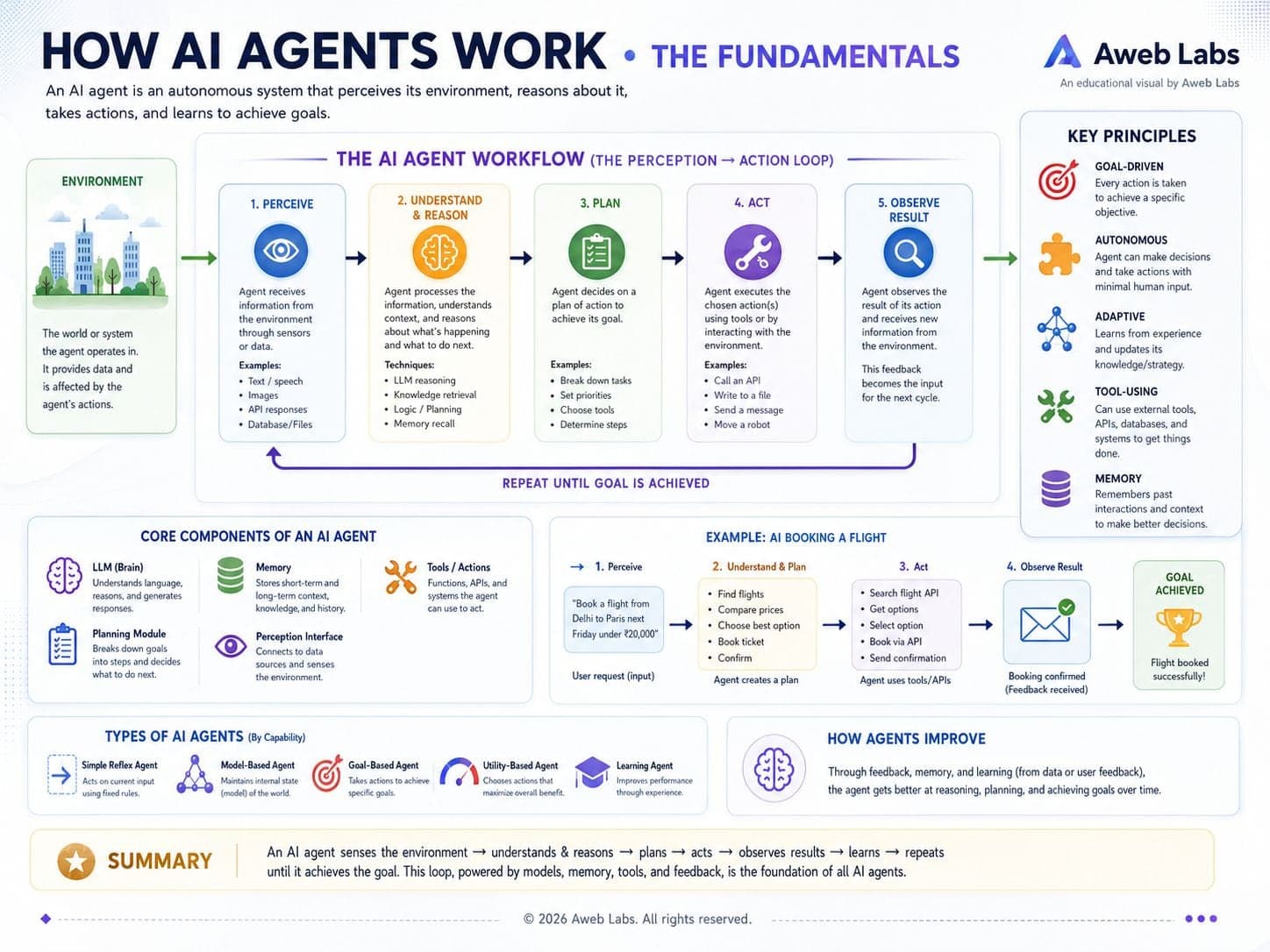
My work accelerated when I began treating every AI interaction as part of a system: mission, context, tools, output, inspection, correction. That is the loop Aweb is trying to make visible.
In that loop, taste still matters. Judgment still matters. Refusal still matters. The machine expands the room, but it does not decide what belongs in it.
Method
The machine needs a room built around it.
A model alone is a bright object in an empty room. It can speak, but the work is still floating. The room is what matters: files it can read, APIs it can call, policies it cannot cross, memory it can reuse, receipts it must leave, and an operator who can say no.
Aweb is my name for that room: missions before motion, tools under rules, provider routing when useful, API/MCP access when allowed, evaluation after action, and enough trace for the next decision to be earned.
Field notes
The honest version is stronger than the mythical one.
What changed for me. AI did not make me less involved. It made involvement denser. I can hold more systems in motion, but only when the work is framed, checked, and corrected.
What I refuse. I do not want a site that pretends the machine is alive, autonomous, or wiser than the operator. I want the opposite: a public record of where the machine helps and where the operator must decide.
What Aweb is for. Aweb is my attempt to build the environment I needed: missions that can use tools, route providers, create artifacts, evaluate results, and leave enough evidence to keep human judgment in the loop.
The goal is not to make the machine look human. The goal is to make the work more inspectable, more repeatable, more ambitious, and still unmistakably mine.