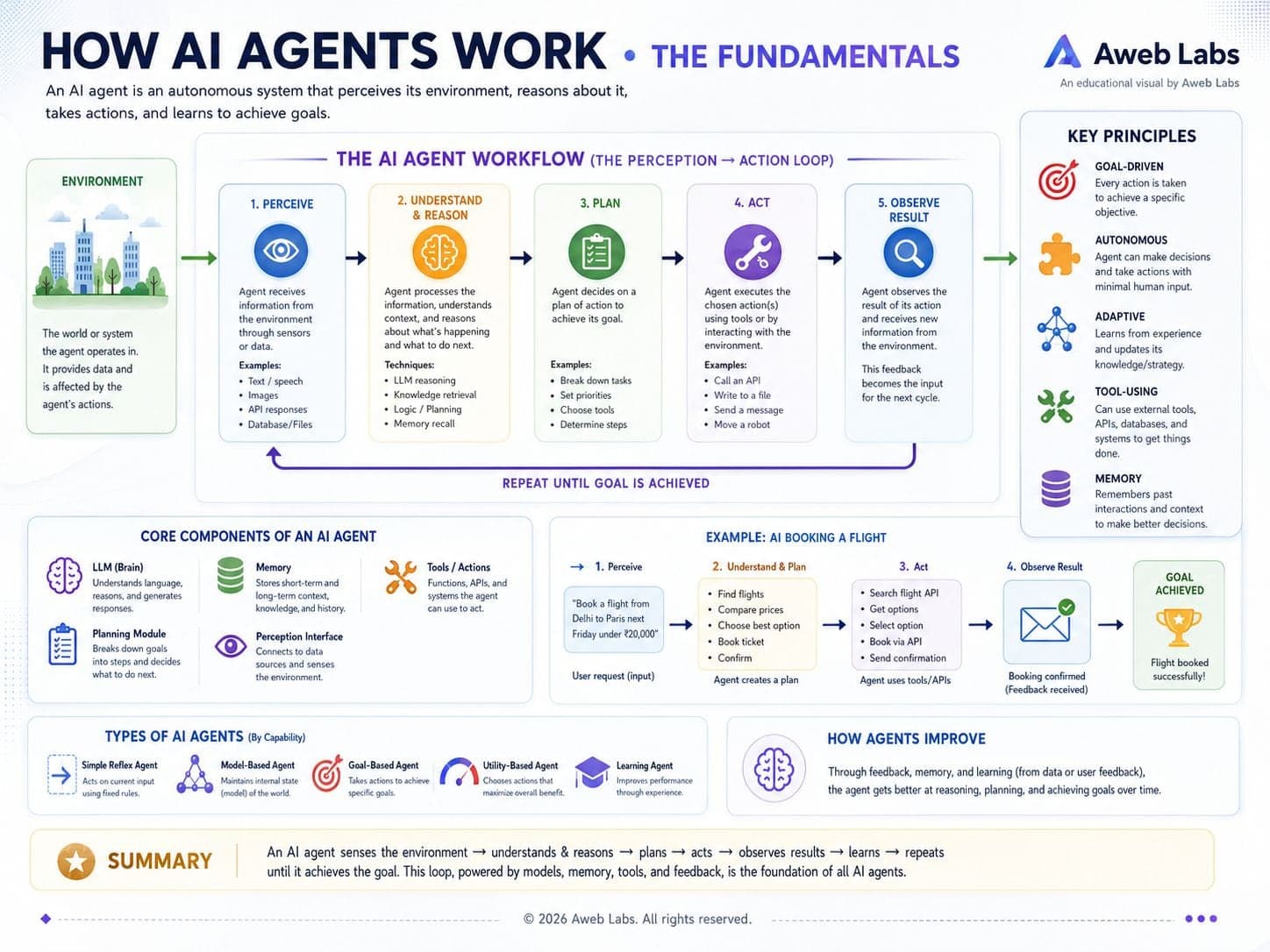
The loop matters more than the label.
Many products call themselves agents because they wrap a model in a chat interface. The useful question is different: can the system carry a mission through multiple steps, use the right tools, observe the result, and leave enough evidence for review?
In Aweb terms, an agent is not a personality. It is a bounded workflow that can move through context, decisions, tools, observations, and corrections while keeping the trace visible enough for an operator to inspect.
PerceiveCollect the prompt, context, files, tool results, constraints, and state that matter.
ReasonTurn context into a plan, choose what to do next, and identify where uncertainty remains.
ActUse tools, call APIs, write files, retrieve data, or produce the artifact under explicit rules.
ObserveRead the result of the action instead of assuming it worked because the model sounded confident.
EvaluateCheck the result against the mission, the boundary, and the evidence needed for trust.
RepeatFeed the result back into the next step until the operator has enough evidence to decide.